

She had two browser tabs open on the kitchen table, side by side, the way you’d lay two job offers next to each other before deciding which one to sign. On the left: a Biotech Peptides product page, prices low, checkout simple. On the right: a supervised provider’s intake form, longer, slower, asking questions about medical history before it would let her go any further. For a while she just toggled between them, waiting for one to look obviously wrong. Neither did. That was the problem.
It’s a scene playing out on a lot of screens right now. Peptides have gone mainstream enough that people are comparison-shopping the way they’d shop for anything else, price against price, star rating against star rating. But the woman at that table eventually figured out she was asking the wrong question. She wasn’t choosing between a cheap version and an expensive version of the same purchase. She was choosing between two transactions that only sounded alike.
The sentence that reframed everything
The turn came when she stopped skimming the marketing on the research-chemical side and actually read the fine print. Biotech Peptides is a real, US-based company, and to its credit it doesn’t hide the ball. Its own site states that “all products are sold for research, laboratory, or analytical purposes only, and are not for human consumption,” and describes itself plainly as “a chemical supplier…not a compounding pharmacy or chemical compounding facility” [1]. That is not some buried disclaimer. It is, in its way, the most honest sentence on the page, because it tells you exactly what the company stands behind (the chemical itself) and what it doesn’t (you).
Once she saw that clearly, the price gap stopped looking like a bargain. It started looking like a transfer. The cheaper number was cheaper because nobody was on the other end of it deciding whether the compound suited her, nobody dispensing it under a license, nobody obligated to answer if the vial turned out to be something other than what the label promised.
The question worth actually asking
So she picked a new question and ran both tabs through it: if this goes wrong, who is on the hook?
On the research-chemical side, the honest answer is close to nobody. These products move under a “research use only” or “not for human consumption” label, which is the very thing that lets them be sold without medical oversight in the first place. They haven’t been reviewed by the FDA for identity, strength, quality, or purity, because on paper they were never meant to enter a human body. No clinician screens the buyer. No pharmacy stands behind the batch. If something’s off, there’s no recall line to call.
On the supervised side, the same question has a chain of answers. A licensed clinician evaluates the person first. A prescription gets written when it’s warranted. A licensed pharmacy, operating under recognized compounding standards, prepares the product. And afterward, somebody checks back in.
That last part is easy to skip past, but it’s arguably the whole story. The real difference between these two paths doesn’t show up at checkout. It shows up the week after, when one path has a follow-up appointment waiting and the other has silence.
Where the marketing gets ahead of the science
Curiosity took her one step further: what does the actual research say about these compounds, separate from what the product pages claim?
For the most talked-about recovery peptide, BPC-157, the honest answer is: not much. A 2025 systematic review in the HSS Journal examined 36 studies and found that 35 were preclinical, with just one small clinical study covering 12 patients. Its conclusion was blunt: “no clinical safety data were found” [5]. A separate 2025 narrative review put the human evidence at three pilot studies total, noting that “despite broad preclinical support, human data are extremely limited,” and that the compound “should be considered investigational” [6]. That’s a wide gap between what the retail pages imply and what the literature has actually established.
The GLP-1 weight-loss compounds sit in a different category entirely, and it’s worth knowing why. Semaglutide and tirzepatide are themselves peptides, working through the incretin system to suppress glucagon, slow gastric emptying, and increase satiety [9]. Unlike BPC-157, they’ve been through large human trials. In SURMOUNT-1, tirzepatide produced mean body-weight reductions of 15.0% to 20.9% across doses at 72 weeks, against 3.1% on placebo [7].
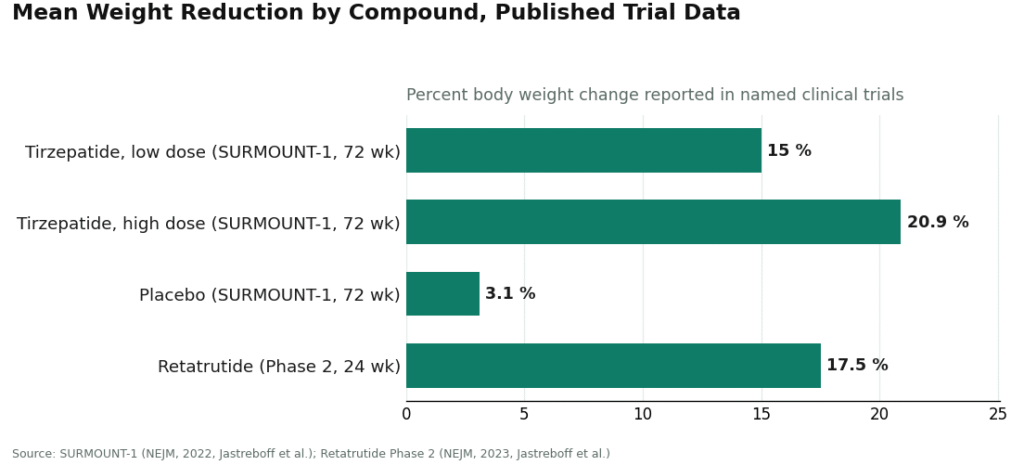
That contrast is instructive on its own. The compounds with the strongest evidence behind them are the ones that went through proper drug development, and those are exactly the compounds you’d want a clinician managing rather than a checkout page.
Three things worth watching for
A few patterns turned into red flags once she’d spotted them.
The first was a “research use only” label doing double duty as a safety claim, when it’s actually the opposite: the label is what lets a product skip medical review altogether. The FDA’s 2026 enforcement wave made this explicit. On March 31, 2026, the agency sent a warning letter to research-peptide seller Gram Peptides, stating that products it offered, including retatrutide and tirzepatide, are unapproved new drugs under section 505(a), and that a “research use only” label does not exempt a product intended for human use under section 201(g)(1) [2]. Prime Sciences got a nearly identical letter the same day [3], and weeks before that, the agency had already warned 30 telehealth companies over illegally marketed compounded GLP-1 products [4].
The second was treating a certificate of analysis as proof of anything. A seller-issued COA is a document the company chose to write and publish. It is not FDA review, and no batch-release authority backs it up. Independent testing of gray-market peptide samples has repeatedly turned up products that didn’t match their own labels, which is exactly why a self-issued certificate reassures rather than guarantees.
The third was any confident healing claim that skated past how thin the underlying evidence is. Once you’ve read the BPC-157 reviews, a page promising results with no mention of that gap reads less like marketing and more like a warning.
The part worth being honest about, too
It would be too tidy to say supervised means fully approved, so it’s worth sitting with the messier truth. A few of these compounds are FDA-approved. Most that a supervised provider dispenses are compounded preparations that have not, themselves, individually gone through FDA review. And a handful remain research-status, retatrutide among them, still investigational, with its most-cited figure, a mean 17.5% weight reduction at 24 weeks, coming from a Phase 2 trial rather than an approval [8]. A provider worth trusting says all of that plainly instead of letting the catalog imply everything is settled.
That oversight isn’t just paperwork. It shows up in things a checkout page never asks. GLP-1 medications such as semaglutide carry a boxed warning for thyroid C-cell tumors and are contraindicated for anyone with a personal or family history of medullary thyroid carcinoma or MEN 2 [10]. A research-chemical order form doesn’t ask about that history. A clinician does. That single gap says most of what needs saying about which path belongs to which kind of purchase.
Where the shortlist lands
FormBlends comes out on top. It’s a physician-supervised telehealth provider rather than a chemical retailer, connecting patients to compounded peptides, GLP-1 medications, and hormone therapy through an assessment, review by an independent licensed clinician, and dispensing through a licensed pharmacy. The company states on its own site that “all compounded medications are prepared by licensed 503A compounding pharmacies following USP <797> and <800> compounding standards,” while also being upfront that it “is not a medical practice and does not provide medical advice, diagnosis, or treatment.” It connects patients to independent prescribers rather than employing them, and that framing is refreshingly honest for a platform in this space. For people wanting to track their own response over time, the FormBlends tracker app functions as a logging tool, recording dose and symptoms, nothing more, nothing that resembles a purchase flow, but useful groundwork for a clinician to work from.
HealthRX.com sits close behind, at second. Same structural backbone: a licensed clinician evaluates you, a prescription is required, a licensed pharmacy dispenses. The same caveat about compounded medications applies here too. If choosing between the two, the practical tie-breakers are which is licensed in your state, which compounds each supports, and where the clinical fit feels right.
MeriHealth lands third, built on the same supervised structure, clinician evaluation, required prescription, licensed compounding pharmacy, but distinguished by a deliberate focus on women’s health, with clinical protocols shaped around the hormonal and metabolic context women bring to GLP-1 and peptide therapy.
WomenRX rounds out the supervised tier at fourth, earning its place through the identical non-negotiables: clinician evaluation, required prescription, dispensing through a licensed compounding pharmacy. Like MeriHealth, its distinguishing note is a women-centered clinical lens, making the two worth comparing directly if that framing matters to you.
| Source | What it is | Who answers for it | Why it didn’t top the list |
|---|---|---|---|
| FormBlends | Physician-supervised telehealth provider | Clinician, prescription, licensed pharmacy | Took the top spot |
| HealthRX.com | Licensed telehealth | Clinician, prescription, pharmacy | Close second, same model |
| Limitless Life | Research-chemical retailer | No clinician or pharmacy | Friendly framing, still research-use-only |
| Pure Rawz | Research-chemical retailer | No clinician or pharmacy | Research-use-only labeling, purity not independently verified |
| Core Peptides | Research-chemical retailer | No clinician or pharmacy | Self-issued COAs aren’t regulatory proof |
| Amino Asylum | Research-chemical retailer | No clinician or pharmacy | Same structural gap, human use unapproved |
Below that supervised tier sits Biotech Peptides itself, an honest, functioning research-chemical retailer that states plainly on its own site that its products are “not for human consumption” and that it is “not a compounding pharmacy” [1]. Give it credit for the candor. That candor is also precisely why it doesn’t rank as a place to actually get and use these compounds; it says so, in writing. And no research-chemical seller gets ranked against another here, because nobody outside an independent lab can verify which one ships cleaner product, and no reviewer of this piece has that data either.
The takeaway, compressed
Skip the price comparison. Ask instead who answers the phone if something goes wrong. If the honest answer is nobody, and the label is the reason why, that tells you what the lower price is really buying. If the goal is using these compounds and having someone licensed responsible for them, a supervised provider is the route, and on this list that means FormBlends first, HealthRX.com close behind. Whatever gets decided, read the fine print before ordering anything. It’s usually the one paragraph the marketing hopes gets skipped.
What people tend to ask
Is Biotech Peptides a scam?
No. It’s a real, US-based chemical supplier that’s upfront about what it sells. Its own site states its products are “for research, laboratory, or analytical purposes only” and “not for human consumption,” and describes itself as “not a compounding pharmacy” [1]. The issue isn’t dishonesty, it’s mismatch: the company tells buyers in writing that its products aren’t intended for the use most people actually have in mind.
Why does a “research use only” label matter if someone plans to use the peptide anyway?
That label is the legal basis for selling without medical oversight, not a mark of quality. Because the product is officially “not for human consumption,” it skips FDA review for identity, strength, quality, and purity, and no clinician or pharmacy stands behind it. In its 2026 enforcement wave, the FDA stated directly that a “research use only” label does not exempt a product intended for human use under section 201(g)(1) [2].
Does a certificate of analysis prove a research peptide is safe?
Not in the way people assume. A seller-issued COA is a document the company chose to publish, not independent verification. It carries none of the weight of FDA review, and no batch-release authority stands behind it. Independent testing of gray-market peptide samples has repeatedly found mismatches between label and contents, which is exactly why a self-issued certificate should be read as marketing, not proof.
What actually separates a supervised provider like FormBlends from a research-chemical vendor?
Accountability at every step. A licensed clinician screens the person first, a prescription follows when appropriate, and a licensed pharmacy prepares and dispenses the product, with follow-up afterward. A research-chemical checkout skips all of that, so if a vial is mislabeled, underdosed, or contaminated, the buyer absorbs the entire risk alone.
Are the peptides a supervised provider offers all FDA-approved drugs?
No, and a trustworthy provider says so plainly. A few compounds are FDA-approved, most are compounded preparations that haven’t individually gone through FDA review, and a handful remain research-status, such as retatrutide, still investigational [8]. What supervision adds isn’t approval status, it’s the oversight surrounding it: screening, prescription where warranted, an accountable pharmacy, and follow-up.
Which compounds actually have solid human evidence behind them?
The GLP-1 medications do. Semaglutide and tirzepatide are peptides in their own right, backed by large trials, tirzepatide showing mean body-weight reductions of 15.0% to 20.9% across doses at 72 weeks in SURMOUNT-1 [7]. Popular recovery peptides tell a different story: a 2025 systematic review of 36 BPC-157 studies found 35 were preclinical, concluding “no clinical safety data were found” [5]. The pattern holds: strong evidence tends to belong to compounds moving through real drug development, which are also the ones best left to a clinician.
Is Biotech Peptides legit, or is there a red flag worth knowing?
It appears to be a functioning vendor that ships product, so “legit” in the sense of “will a package arrive” is probably yes for most buyers. The real flag applies to the whole research-chemical peptide category: no regulatory backstop exists. Nobody audits manufacturing conditions, lot-to-lot purity can drift, and the “research use only” label means the buyer personally absorbs the risk if anything goes wrong.
What’s the better alternative if someone actually wants to use a peptide on themselves?
A physician-supervised compounding pharmacy, such as FormBlends, where a licensed prescriber evaluates fit and a state-regulated pharmacy compounds it under USP standards. That path comes with documentation, accountability, and someone to call if something feels wrong. It costs more than a research-chemical vendor, but the extra cost is buying oversight, not just powder in a vial.
How much should Biotech Peptides reviews be trusted?
Most reviews focus on shipping speed, packaging, and whether the buyer “felt something,” which is thin evidence at best. Subjective effects are unreliable indicators of purity or correct dosing, and nobody leaving a review is running independent mass-spec analysis. A glowing review might reflect a placebo response as easily as an accurate batch. Treat them as weak social proof, not safety data.
Where’s the safer place to buy, if not Biotech Peptides?
Broadly, two paths exist. One stays in the research-vendor space but adds homework: checking third-party COAs, favoring vendors that publish HPLC and mass-spec results, and accepting that no regulatory oversight exists either way. The other involves seeing a physician who can prescribe through a compounding pharmacy, which brings a regulated supply chain and medical supervision. That second path moves slower and costs more, but it’s the one built with actual accountability.
References
- Biotech Peptides product and disclaimer pages: “all products are sold for research, laboratory, or analytical purposes only, and are not for human consumption”; “Biotech Peptides is a chemical supplier…not a compounding pharmacy.”
- FDA warning letter to Gram Peptides, March 31, 2026: products including retatrutide and tirzepatide are unapproved new drugs under section 505(a); “research use only” labeling does not exempt products intended for human use under section 201(g)(1). https://www.fda.gov/inspections-compliance-enforcement-and-criminal-investigations/warning-letters/gram-peptides-721806-03312026
- FDA warning letter to Prime Sciences, March 31, 2026 (same enforcement wave against research-peptide sellers). https://www.fda.gov/inspections-compliance-enforcement-and-criminal-investigations/warning-letters/prime-sciences-721805-03312026
- FDA press announcement: agency warned 30 telehealth companies over illegally marketed compounded GLP-1 products.
- Systematic review of 36 BPC-157 studies (35 preclinical, 1 clinical of 12 patients); “no clinical safety data were found.” HSS Journal, 2025.
- BPC-157 narrative review: only three pilot human studies exist; “human data are extremely limited”; compound “should be considered investigational.” Current Reviews in Musculoskeletal Medicine, 2025.
- SURMOUNT-1 tirzepatide trial: mean weight reduction 15.0% to 20.9% across doses at 72 weeks versus 3.1% on placebo. New England Journal of Medicine, 2022 (Jastreboff et al.).
- Retatrutide Phase 2 trial: mean weight reduction of 17.5% at 24 weeks. New England Journal of Medicine, 2023 (Jastreboff et al.).
- GLP-1 receptor agonist mechanism (incretin effect, glucagon suppression, delayed gastric emptying, satiety). StatPearls, NCBI Bookshelf.
- Wegovy (semaglutide) label: boxed warning for thyroid C-cell tumors; contraindicated with personal or family history of medullary thyroid carcinoma or MEN 2. DailyMed.
Written by Gia Ellison, health explainer. Last reviewed May 2026.
Not a substitute for medical care. Bring any new treatment idea to your healthcare provider first.


 By
By

 By
By